No products in the cart.
PowerPack Off Canvas Cart
100% Secure Checkout!
View your shopping cart
$0.00
0
0 items in cart
By Deborah Gray-Young, PCC · Executive & Leadership Coach · dgrayyoung.com
Most experienced professionals have sat through a SWOT analysis in a conference room at some point in their careers. Strengths + Weaknesses + Opportunities + Threats. Drawn on a whiteboard. Applied to a product launch, a market strategy, or a quarterly business review.
Very few have ever applied that same framework to themselves.
That is a significantly missed opportunity — particularly for professionals navigating career change after 20 years of experience. Because a personal SWOT analysis done honestly and deliberately reveals things about your professional position that no resume, no LinkedIn profile, and no amount of networking conversation will surface on its own.
It is one of the most clarifying tools I use with coaching clients. And it is consistently one of the most uncomfortable, which is exactly why it works.
Here is what most career change advice misses entirely.
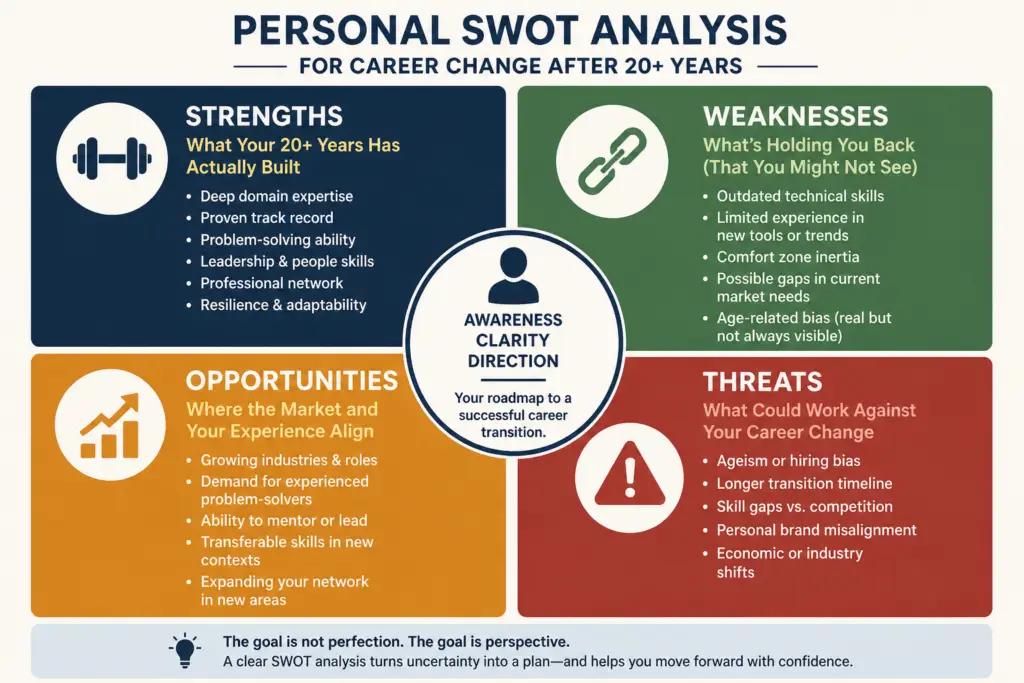
After 20+ years in a field, experienced professionals carry a specific set of blind spots that younger professionals simply don’t have yet. The very depth of experience that makes you valuable also makes certain patterns invisible to you — patterns in how you work, how you lead, how you are perceived, and where your real gaps lie.
As Deborah has written for The BOSS Network, the professionals who navigate career transitions most successfully are not necessarily the ones with the most impressive credentials. They are the ones with the clearest picture of where they actually stand — strengths, gaps, opportunities, and all.
A personal SWOT analysis for career change is how you build that picture. Additionally, it forces a quality of honest self-assessment that most professionals avoid because it is uncomfortable — and that discomfort is precisely where the most valuable insight lives.
The strengths quadrant of a personal SWOT analysis is where most experienced professionals both overestimate and underestimate themselves simultaneously.
Overestimate — because they list job titles and industry-specific expertise that may not transfer as directly as they assume. Underestimate — because the capabilities that actually travel furthest are so deeply embedded in how they operate that they have stopped seeing them as strengths at all.
For a personal SWOT analysis that serves your career change after 20 years, strengths must be defined in terms of capability — not credential.
Ask yourself these specifically:
What do people consistently come to me for, regardless of my title or organization?
What situations do I walk into where I immediately know what to do — even when the context is new?
What have I accomplished that a less experienced professional in my field genuinely could not have delivered?
Those answers — not your job descriptions — are your real strengths. As covered in How to Know What Your Experience Is Really Worth in a New Field, the most durable professional capabilities travel across industries. Strategic judgment, leadership under pressure, stakeholder management, and the ability to navigate organizational complexity are personal assets. They go where you go.
This is the quadrant most people rush through or soften beyond usefulness.
A weakness listed as “I sometimes work too hard” or “I care too much about quality” is not a weakness. It is a deflection. And deflections do not help you navigate a career change after 20 years — they just delay the reckoning.
Real weaknesses for experienced professionals navigating career change look more like these:
None of those weaknesses disqualify you. However, all of them require honest acknowledgment and a deliberate plan. Because the gap between where you are and where you want to go is only manageable if you can see it clearly. Pretending it doesn’t exist doesn’t make it smaller. It makes you less prepared.
The opportunities quadrant of your personal SWOT analysis shifts the focus outward — from what you bring to what the environment is making available.
For professionals of color navigating career change after 20+ years, this quadrant deserves particular attention. Research from McKinsey & Company consistently shows that organizations are increasingly prioritizing diverse leadership at senior levels — creating genuine openings for experienced professionals of color that did not exist at the same scale a decade ago.
Additionally consider:
Opportunities do not chase you. Identifying them requires deliberate research — which is exactly what Chapter 8 of the YOU 3.0 Career Transition Workbook is designed to support.
The threats quadrant is where experienced professionals tend to either catastrophize or minimize — and neither extreme serves the process.
Catastrophizing sounds like: “Ageism will disqualify me everywhere I apply.” Minimizing sounds like: “I have 20 years of experience — none of that applies to me.”
Neither is accurate. Both are avoidance.
Real threats worth naming honestly include:
Naming threats is not pessimism. It is strategic realism. As explored in You Are Not Starting Over — You Are Repositioning, the professionals who navigate career change most effectively are the ones who see the terrain clearly — including the difficult parts — and plan accordingly.
A completed personal SWOT analysis is not the end of the work. It is the beginning of it.
Here is how to put it to use immediately.
Match your strengths to opportunities. Where do your most portable capabilities align with what your target field or role genuinely needs? That intersection is your positioning.
Build a plan around your weaknesses. Each real weakness you named should have a corresponding action — a course, a relationship, a deliberate practice that begins closing the gap before you need it closed.
Factor threats into your timeline. If bias or a longer search timeline is a real threat, your financial planning and your transition strategy need to account for it explicitly — not optimistically.
Download the YOU 3.0 Career Transition Workbook — Chapter 5 walks you through your complete personal SWOT analysis with structured prompts designed specifically for experienced professionals navigating career change.
Block two uninterrupted hours. Not a lunch break. Not ten minutes between meetings. Two hours where you can think without interruption.
Work through each quadrant in order — strengths, weaknesses, opportunities, threats. Write without editing. The first draft of a personal SWOT analysis should be honest before it is polished.
Then sit with it for 24 hours before you do anything with it. The most important insights often surface after you have stepped away from the page.
For direct guidance on working through your personal SWOT analysis and building your complete career change strategy, work with Deborah. This is a professional investment in your next chapter — and one of the most strategic ones you can make.
Deborah Gray-Young, PCC is a former advertising agency executive and ICF-certified executive coach who advises senior professionals and SMB CEOs. She specializes in helping professionals of color — men and women — navigate career change after 20+ years and lead with greater clarity and intention. Learn more at dgrayyoung.com or explore her executive coaching services.
Related Reading → How to Know What Your Experience Is Really Worth in a New Field → You Are Not Starting Over — You Are Repositioning → How to Build Your 90-Day Career Transition Roadmap → Who’s Holding Your Ladder? The Support System Every Professional of Color Needs → What No One Tells You About Career Transition After 40 → YOU 3.0 Career Transition Workbook

