No products in the cart.
PowerPack Off Canvas Cart
100% Secure Checkout!
View your shopping cart
$0.00
0
0 items in cart
No products in the cart.
If you’re serious about a career transition, industry research is not optional — it is the move that separates professionals who land well from those who stay stuck.
By Deborah Gray-Young, PCC · Executive & Leadership Coach · dgrayyoung.com
Let’s be honest. When most professionals think about changing careers, they do one of two things: they update their résumé, or they start applying. What they almost never do — at least not strategically — is study the industry they are trying to enter.
Career transition industry research sounds straightforward. In practice, however, it is one of the most skipped steps in the entire process. And that gap is expensive.
Because here is what happens when you walk into a new industry without doing the work: you speak the wrong language. You highlight the wrong experience. You apply for roles that fit your title instead of your actual capability. And you wonder why the callbacks are not coming.
The professionals who navigate career transitions well do not just send their experience forward. They translate it. That translation requires knowing exactly what the new industry values — and that knowledge only comes from deliberate, structured research.
Research in this context is not reading industry news over your morning coffee. That is awareness. Research is a structured process of learning how a new field thinks, what it rewards, who holds influence, and where the gaps are that your experience is uniquely positioned to fill.
Specifically, it means understanding four things:
Each of those four areas maps directly to how you will position yourself — in your materials, in your conversations, and in interviews. Without that map, you are navigating blind.
Chapter 8 of the YOU 3.0 Career Transition Workbook walks you through a structured industry overview process designed specifically for professionals making a significant career shift. It is not a reading list. It is an analytical framework — and it works.
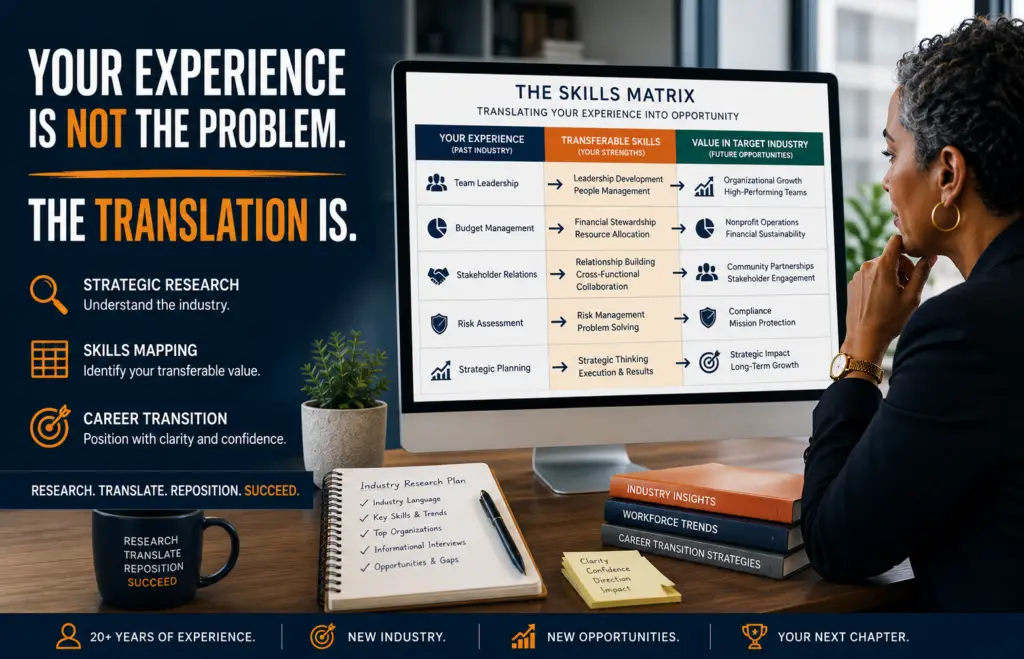
One of the most powerful tools I use in my leadership coaching services is what I call the skills matrix — a structured grid that maps your existing experience against the requirements of your target industry.
The premise is simple: most professionals significantly underestimate how much of their experience transfers. Therefore, they either undersell themselves or fail to connect the dots for a hiring decision-maker who does not yet know them.
The skills matrix forces you to make those connections explicit. Consider a senior professional with 20 years in financial services who wants to transition into nonprofit leadership. On the surface, those worlds look different. Underneath, however, the transferable experience is substantial: budget management, stakeholder relations, board governance, risk assessment, team leadership, and strategic planning.
The matrix does not just list those skills. It reframes them in the language the new industry uses — which is where most professionals stop short.
Your experience is not the problem. The translation is.
Workshop Module 2 in Deborah’s strategic career framework covers exactly this: Skill Mapping and Strengths Translation. The YOU 3.0 workbook serves as the companion tool — giving you the structured space to build your own matrix before you ever walk into a room.
After working with professionals at every stage of career transition, I can tell you that the obstacles are rarely what people think they are. The following three patterns show up consistently — and each one is directly addressed by structured industry research.
Most professionals search for roles using the same title they currently hold or one rung above it. However, in a new industry, that title may not exist — or it may mean something entirely different. Researching how your function is structured in the target industry shows you where you actually fit, not where you assume you fit.
Experience described in the past tense — “I managed a team of 15” — reads as history. Experience framed in terms of capability — “I build and lead high-performance teams through periods of significant organizational change” — reads as a value proposition. That reframe requires knowing what the new industry is actually buying. Research tells you that.
Readiness is a moving target. For many professionals — particularly women of color navigating industries where they have been underrepresented — the readiness bar gets set impossibly high. Industry research has a practical benefit beyond information: it builds confidence. The more you know about a space, the more natural it feels to enter it. Knowledge replaces hesitation with strategy
Structured career transition research does not require months of preparation. It requires the right sources, used deliberately. Here is the framework I recommend:
According to a LinkedIn Workforce Report, professionals who conduct structured research before making a career move are significantly more likely to report satisfaction with their transition outcomes within the first year. The investment in research is not separate from the transition — it is the transition.
A senior director I worked with — 22 years in corporate communications — had been telling herself for two years that she was not qualified to move into executive consulting. Her evidence? She had never held a consulting title.
When we built her skills matrix and mapped it against what consulting firms in her target sector actually required, the picture changed entirely. Her experience in stakeholder communications, executive messaging, crisis narrative, and cross-functional leadership was not adjacent to what they needed. It was exactly what they needed.
The research did not create her qualifications. It made them visible — first to her, then to the market. Within four months of completing her industry research and repositioning her materials accordingly, she had signed her first consulting engagement.
That outcome is not unusual. However, it is also not accidental. It follows directly from doing the research most professionals skip.
Professionals seeking this kind of structured support can explore Deborah’s executive coaching services — or learn more about her executive consulting work with organizations navigating leadership transitions.
Chapter 8 of the YOU 3.0 Career Transition Workbook is built around exactly this work: a structured industry overview process that gives you a clear analytical framework for understanding the field you are entering — and how your experience positions you within it.
The workbook does not tell you what to do next. It gives you the structure to figure it out yourself — which is the only approach that actually holds up when you are in the room.
→ Get the YOU 3.0 Career Transition Workbook: store.dgrayyoung.com/thewisdomandleadershipvault-464585
For direct, personalized guidance on your career transition, work with Deborah at dgrayyoung.com/contact. This is a professional investment in your next chapter.
Deborah Gray-Young, PCC is a former advertising agency executive and ICF-certified executive coach who advises senior professionals and SMB CEOs. She specializes in helping experienced professionals — particularly women of color — navigate career transitions and lead with greater clarity and intention. Learn more at dgrayyoung.com or explore her executive coaching services.
Found this useful? Share it with a colleague who is ready to stop searching and start transitioning strategically.
Related Reading
→ 5 Steps to Becoming Politically Savvy at Work
→ Stop Calling It Imposter Syndrome — Own Your Power
→ How to Talk About Your Career Transition Without Apologizing
→ You Are Not Starting Over — You Are Repositioning
→ Executive Coaching Services — dgrayyoung.com

Sign up to our newsletter
