No products in the cart.
PowerPack Off Canvas Cart
100% Secure Checkout!
View your shopping cart
$0.00
0
0 items in cart
Evaluating career opportunities should get easier with experience. For most professionals, however, the opposite is true — and the reason is not what they think. By Deborah Gray-Young, PCC · Executive & Leadership Coach · dgrayyoung.com
There is a particular kind of exhaustion that comes not from working too hard, but from working too long in the wrong direction. It is the fatigue of a professional who has been competent, consistent, and quietly miserable — doing excellent work in a role, an industry, or an organization that stopped fitting years ago.
If that sounds familiar, you are not alone. The clients who come to me in this state are not underperformers. They are high achievers who have outgrown their current chapter and are standing at the edge of a real transition — scared to step forward, more scared to stay.
Here is what I tell them: burnout is not the problem. Burnout is the signal. And the breakthrough — the career opportunity that actually fits — is almost always already in the room. The obstacle is not the opportunity itself. It is the evaluating career opportunities process that has broken down.
Most professionals at this stage are not lacking options. They are lacking a framework for deciding which option is actually the right one — and the confidence to commit to a decision once they make it.
Second-guessing is not a character flaw. However, when it becomes the default response to every new opportunity, it stops being caution and starts being avoidance.
Three patterns consistently show up when professionals struggle with opportunity evaluation:
The known is comfortable. Therefore, professionals often evaluate new opportunities against what they already have — rather than against what they actually need. An opportunity that looks different from the current role gets dismissed as risky, when in reality it may be the better alignment. Familiarity is not the same as fit.
“I need more information before I decide” is sometimes true. More often, however, it is fear of making the wrong choice dressed up as due diligence. The professional keeps researching, keeps waiting, keeps asking — because as long as a decision has not been made, the outcome cannot be wrong. That is not strategy. That is stalling.
Career decisions made entirely inside your own head are rarely your best decisions. Without an objective outside perspective — a coach, a trusted mentor, a peer who will tell you the truth — the internal narrative tends to loop. You end up confirming what you already believe rather than genuinely testing it.
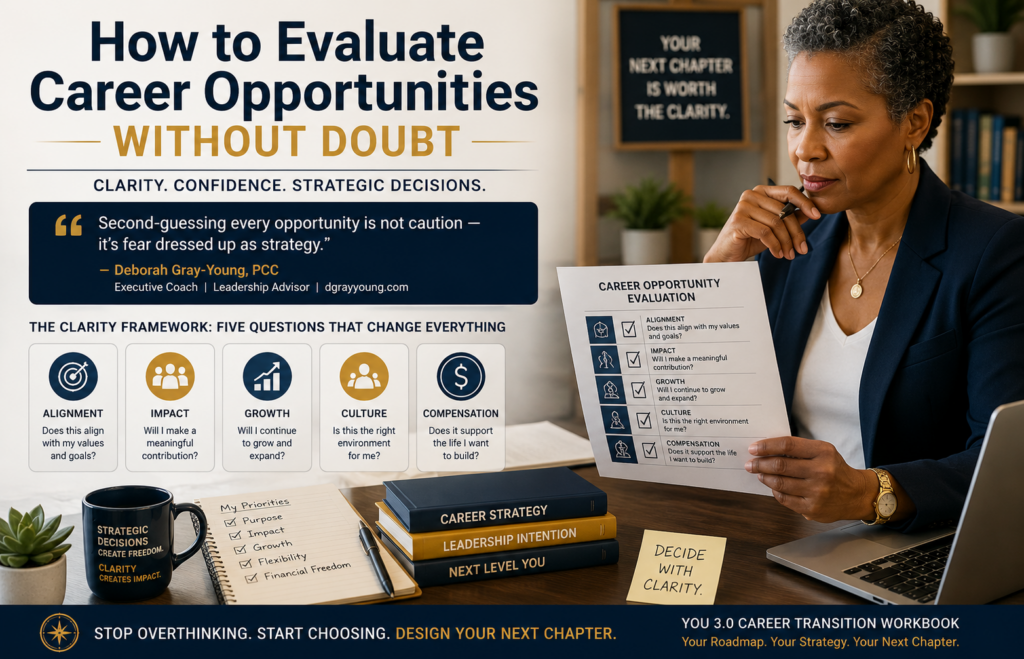
Chapter 9 of the YOU 3.0 Career Transition Workbook introduces a structured opportunity evaluation tool built around five core questions. These are not screening questions — they are clarity questions. The goal is not to eliminate risk but to ensure the decision is made with your actual values and goals in view, not your anxiety.
Every opportunity needs to be evaluated against your forward trajectory, not your past title. If the role fits the version of you that existed three years ago but not the professional you are becoming, that is critical information. Alignment is not about comfort. It is about direction.
Culture fit is real — and it is frequently underweighted in the evaluation process. Therefore, go beyond the mission statement. Ask about decision-making structures, how conflict is handled, what happens when someone raises a dissenting view, and who gets promoted. The answers reveal more than any job description.
This is not a disqualifying question — it is a growth question. Identifying the gap between your current capability and the role’s requirements tells you exactly what you will need to build or hire around. Additionally, it tells you whether the stretch is energizing or depleting, which is one of the clearest indicators of long-term fit.
This is the question most professionals never ask. However, it is the most important one. Every role shapes you — your habits, your relationships, your identity as a professional. Consider whether the version of you that emerges from two years in this role is someone you want to become.
Decisions are not just about what you gain. They are also about what you forego by staying still. Consequently, evaluating the cost of inaction is as important as evaluating the risk of action — and it is a question most professionals in second-guessing mode never honestly answer.
Second-guessing is not the same as due diligence. Know the difference.
5 Signs You Are Ready for a Career Transition — Right Now
One of the most consistent themes in my executive coaching work is professionals who are ready for a transition but have convinced themselves they are not. The following five signs are drawn directly from patterns I observe — and from the clients who eventually moved forward successfully.
- You are performing well but feel increasingly disconnected from the work.
- You find yourself energized by conversations about roles or industries outside your current one.
- The thought of doing this exact job for three more years produces dread rather than motivation.
- You have been passed over, overlooked, or underutilized — and you know it is not a performance issue.
- You keep waiting for the “right time” — and the right time never seems to arrive.
If three or more of those resonate, you are not approaching readiness. Furthermore, you are already there. The gap between recognizing that and acting on it is precisely what the YOU 3.0 Career Transition Workbook is designed to close.
Strategic Action Starts With a Decision, Not a Plan
Workshop Module 4 in Deborah’s strategic career framework is titled “Strategic Action and Networking Activation” — and it begins with a premise that surprises many professionals: the action plan comes second. The decision comes first.
Because here is what happens when professionals build an action plan before making a genuine decision: the plan becomes a hedge. Every step is designed to keep options open rather than move forward. As a result, the networking feels transactional, the outreach feels forced, and the entire process stalls — not because the professional lacks capability, but because they are executing a plan for a direction they have not actually committed to.
Genuine strategic action — the kind that produces results — flows from a decision that has been made with clarity and owned with confidence. That decision does not require certainty. It requires commitment.
Organizations supporting professionals through leadership transitions can also learn more about Deborah’s executive consulting services — designed for organizations navigating change alongside their people.
What One Client Learned When She Stopped Waiting
A VP-level professional came to me after turning down two strong opportunities in eighteen months. Both times, she had cited the same reason: the timing was not right. Her current role was stable, and she did not want to make a move she might regret.
When we worked through the clarity framework together, however, the picture shifted. The timing, it turned out, was not the real concern. The real concern was that she did not trust her own evaluation. After years of operating in an environment where her judgment had been second-guessed by others, she had internalized that doubt — and was now second-guessing herself before anyone else had the chance to.
We rebuilt her evaluation process from the ground up, anchored in her actual values and career goals rather than in the anxiety of getting it wrong. Within six months, a third opportunity emerged. This time, she evaluated it clearly, decided deliberately, and accepted it with confidence.
She has not looked back. Additionally, she now has a framework she can use for every subsequent decision — which may be the more valuable outcome.
She also received career transition guidance — a structured process for professionals seeking clarity and confidence at critical turning points. Learn more about how leadership coaching services can support your next career decision.
Chapter 9 of the YOU 3.0 Career Transition Workbook gives you the structured opportunity evaluation framework covered in this post — in a format designed for you to work through with your actual options in front of you.
It does not make the decision for you. Instead, it gives you the clarity to make it yourself — which is the only kind of decision that holds up under pressure.
→ Get the YOU 3.0 Career Transition Workbook: store.dgrayyoung.com/thewisdomandleadershipvault-464585
For direct, personalized guidance on your career transition, work with Deborah at dgrayyoung.com/contact. This is a professional investment in your next chapter.
Deborah Gray-Young, PCC is a former advertising agency executive and ICF-certified executive coach who advises senior professionals and SMB CEOs. She specializes in helping experienced professionals — particularly women of color — navigate career transitions and lead with greater clarity and intention. Learn more at dgrayyoung.com or explore her executive coaching services.
Found this useful? Share it with a colleague who keeps saying the timing is not right.
→ The New Industry Research Most Professionals Skip
→ 5 Steps to Becoming Politically Savvy at Work
→ Stop Calling It Imposter Syndrome — Own Your Power
→ You Are Not Starting Over — You Are Repositioning
→ How to Talk About Your Career Transition Without Apologizing

