No products in the cart.
PowerPack Off Canvas Cart
100% Secure Checkout!
View your shopping cart
$0.00
0
0 items in cart
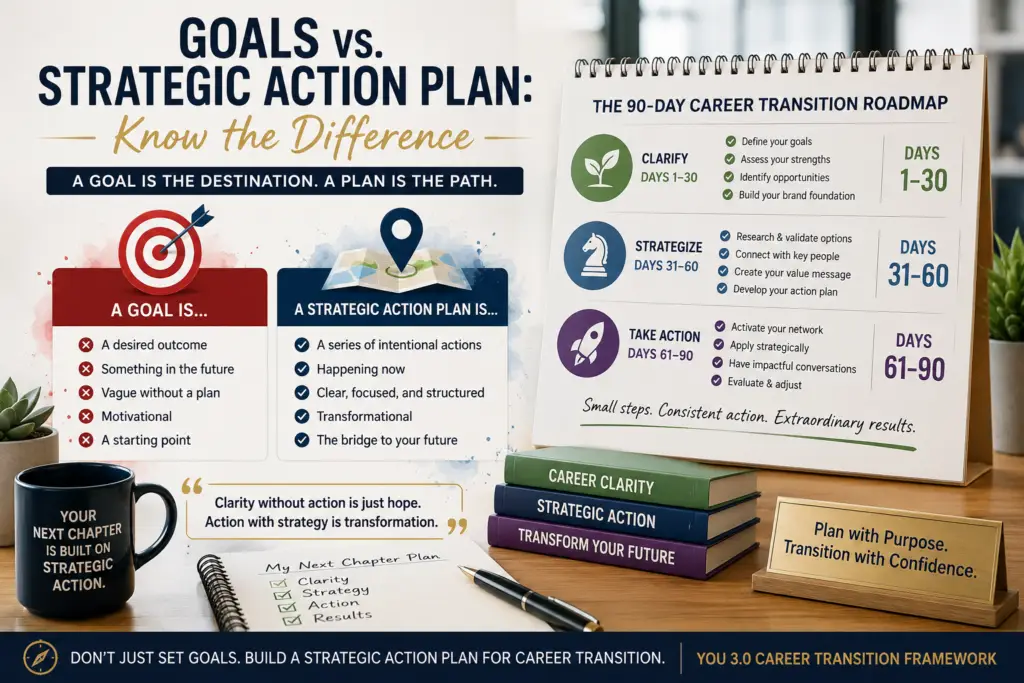
A goal tells you where you want to go. A strategic action plan is how you actually get there — and confusing the two is one of the most expensive mistakes professionals make in career transition. By Deborah Gray-Young, PCC · Executive & Leadership Coach · dgrayyoung.com
Before you build anything — before you update a single line of your résumé or reach out to a single contact — there are three questions every professional in career transition needs to answer honestly. These are not screening questions. They are orientation questions. Without clear answers, any plan you build will be a plan for someone else’s career.
The first question: What do I actually want — not what I am qualified for, not what makes sense on paper, but what I genuinely want to do next?
The second question: What does success look like in 12 months — specifically? Not “a better role” or “more fulfillment.” What is the concrete outcome that tells you the transition worked?
The third question: What am I willing to do differently? A strategic action plan for career transition is not a to-do list. It is a behavior change document. If the answer to this question is “not much,” the plan will not hold.
These three questions open Chapter 10 of the YOU 3.0 Career Transition Workbook for exactly this reason. Everything that follows in the strategic action plan flows from how honestly you answer them.
One of the most persistent and damaging narratives in career transition is the idea that experience — particularly for professionals with 20 or more years in a field — is a liability. Too senior. Too specialized. Too expensive. Too set in their ways.
Let’s name that for what it is: fiction. Useful fiction, perhaps, for organizations that would rather hire inexperience at a lower cost. But fiction nonetheless.
The reframe that changes everything — and one of the core principles in Deborah’s coaching framework — is this: experience is not baggage. Experience is your most differentiated asset. The strategic action plan for your career transition is not a document that minimizes your history. It is a document that translates it.
Every year you have spent leading teams, solving problems, managing through complexity, building relationships, and delivering results is transferable. However, it only transfers when it is framed in the language the new environment uses — which is precisely what a well-built strategic action plan forces you to do.
Course Module 1 in Deborah’s framework is titled exactly this: “Reframe the Narrative — Experience Does Not Equal Baggage.” That reframe is not just a mindset shift. It is the analytical foundation from which your entire transition strategy is built.
Your history is not the obstacle. The way you are presenting it might be.
A goal is a destination. It is a clear, specific statement of an outcome you intend to achieve. Goals are essential — without them, a career transition becomes a drift. However, a goal alone does not move you anywhere.
Here is where most professionals stall. They set a goal — “I want to move into consulting” or “I want a VP-level role in a mission-driven organization” — and then they wait. They update their LinkedIn profile, tell a few people, maybe apply to a handful of roles. When nothing immediately materializes, they conclude the goal was unrealistic.
The goal was not the problem. The absence of a strategic action plan was.
The 90-Day SMART Goals Planner from Workshop Module 4 in Deborah’s framework addresses this directly — pairing each goal with a corresponding set of actions, milestones, and accountability checkpoints. It is designed to be used alongside Chapter 10 of the YOU 3.0 Career Transition Workbook as an integrated planning system, not as a standalone exercise.
A strategic action plan for career transition is not a list of things to do. Consequently, it looks very different from a project management checklist — and professionals who treat it like one consistently underperform on execution.
Here is what a well-built plan actually contains:
A goal is a destination. It is a clear, specific statement of an outcome you intend to achieve. Goals are essential — without them, a career transition becomes a drift. However, a goal alone does not move you anywhere.
Here is where most professionals stall. They set a goal — “I want to move into consulting” or “I want a VP-level role in a mission-driven organization” — and then they wait. They update their LinkedIn profile, tell a few people, maybe apply to a handful of roles. When nothing immediately materializes, they conclude the goal was unrealistic.
The goal was not the problem. The absence of a strategic action plan was.
A goal answers the question: what? A strategic action plan answers three different questions: how, when, and with what resources? Without those three answers, a goal is aspirational at best and paralyzing at worst — because the gap between where you are and where you want to be remains undefined and therefore unsurmountable.
You have likely heard of SMART goals — specific, measurable, achievable, relevant, and time-bound. For career transitions, SMART goals are necessary but not sufficient. A goal can meet every SMART criterion and still produce no results if the supporting action plan is absent or vague.
The 90-Day SMART Goals Planner from Workshop Module 4 in Deborah’s framework addresses this directly — pairing each goal with a corresponding set of actions, milestones, and accountability checkpoints. It is designed to be used alongside Chapter 10 of the YOU 3.0 Career Transition Workbook as an integrated planning system, not as a standalone exercise.
A strategic action plan for career transition is not a list of things to do. Consequently, it looks very different from a project management checklist — and professionals who treat it like one consistently underperform on execution.
Here is what a well-built plan actually contains:
That last element is the one most professionals skip. As a result, the plan becomes a document rather than a living tool — something that gets built once and then quietly forgotten. Accountability is not a soft add-on. It is what transforms a plan into a transition.
Professionals seeking structured support to build this kind of plan can explore Deborah’s executive coaching services — designed for professionals who are serious about executing a real transition, not just thinking about one.
Ninety days is not arbitrary. It is long enough to build real momentum and short enough to maintain urgency. Additionally, it aligns with how most organizations think about onboarding, performance cycles, and role evaluation — which means it maps naturally to the professional environments you are trying to enter.
Here is how the 90-day career transition roadmap breaks down in Deborah’s framework:
This phase is about building the infrastructure of the transition — not executing it. By the end of Day 30, you should have completed your industry research, built your skills matrix, finalized your transition narrative, and identified your top 20 target organizations or role categories. Nothing goes out until the foundation is solid.
This phase is about strategic outreach and relationship building. Informational conversations, visibility in the right professional communities, and deliberate networking — all guided by the stakeholder map built in Phase 1. Additionally, this is when your updated materials go live: résumé, LinkedIn profile, and any other positioning tools.
Days 61–90: Evaluation and Adjustment {#days-61-90}
By Day 60, you have data. Therefore, Day 61 begins with an honest review: what is working, what is not, and what needs to change. Transitions rarely unfold exactly as planned — the professionals who succeed are not the ones whose plan was perfect. They are the ones who adjusted effectively when the plan met reality.
This three-phase structure is built into Chapter 10 of the workbook. It gives you a concrete framework to execute — not a vague directive to “get out there and network.”
After years of working with professionals in career transition, the failure patterns are consistent. Therefore, they are worth naming directly — because awareness of them is half the prevention.
None of these are character flaws. However, each one is a solvable problem — and each one is addressed directly in the YOU 3.0 Career Transition Workbook and in Deborah’s leadership coaching services.
A director-level professional came to me having spent eight months in an unfocused job search. She had applied to over 60 roles. Three callbacks. No offers. Her assessment: the market was not responding to her experience.
My assessment was different. The market was not responding to her positioning. Because her search had no strategic structure, she was applying broadly and landing narrowly — presenting herself as a generalist in a market that rewards specialists who can articulate their specific value.
We stopped the search entirely for two weeks. During that time, we built her strategic action plan from scratch — starting with the three orientation questions, moving through the industry research and skills translation work from earlier chapters of the workbook, and landing on a 90-day roadmap with clear phases and weekly milestones.
By Day 45, she had two first-round interviews. By Day 78, she had an offer — at a level above her previous role, in an industry she had not previously considered but that her research had identified as a strong fit for her transferable experience.The market had not changed. Her approach had. That is what a strategic action plan actually does.
The market had not changed. Her approach had. That is what a strategic action plan actually does.
Chapter 10 of the YOU 3.0 Career Transition Workbook is where the strategic action plan comes together — drawing on everything you have built in the previous nine chapters and translating it into a concrete, phased roadmap for your transition.
It is also where the 90-Day SMART Goals Planner from Workshop Module 4 integrates directly — giving you both the strategic framework and the tactical structure to execute it.
→ Get the YOU 3.0 Career Transition Workbook: store.dgrayyoung.com/thewisdomandleadershipvault-464585
For direct, personalized guidance on your career transition, work with Deborah at dgrayyoung.com/contact. This is a professional investment in your next chapter.
The YOU 3.0 Career Transition Workbook is your first step. For those ready to go deeper — something more is coming. Stay connected at dgrayyoung.com.
Deborah Gray-Young, PCC is a former advertising agency executive and ICF-certified executive coach who advises senior professionals and SMB CEOs. She specializes in helping experienced professionals — particularly women of color — navigate career transitions and lead with greater clarity and intention. Learn more at dgrayyoung.com or explore her executive coaching services.
Found this useful? Share it with a colleague who has the goal but not yet the plan.
Related Reading
→ How to Evaluate Career Opportunities Without Second-Guessing Yourself
→ The New Industry Research Most Professionals Skip
→ 5 Steps to Becoming Politically Savvy at Work

